A Persian rug is often the one piece in a room people are nervous about. It may have been a big purchase, a family piece, or something picked up at an estate sale that nobody quite knows the story of. So when a spill happens, or the rug just looks dull, the question is how to clean a Persian rug without doing lasting harm.
The short answer: routine care at home means gentle vacuuming and careful spot cleaning. Full washing is professional work, and for a valuable or antique rug it may be work for a rug specialist.
This guide covers what you can safely do yourself, what to avoid, how to tell whether a rug is really hand-knotted, and when to hand it over. For wool area rugs in general, our guide on cleaning a wool rug at home covers the basics; this one focuses on hand-knotted Persian and Oriental rugs.
Contents
- First, is it a real Persian rug?
- Vacuuming: the most important routine care
- How to clean a Persian rug spill, step by step
- What to use and what to avoid
- Caring for the fringe
- Can you dry clean a rug?
- Sun, dust, moths and storage
- Are old Persian rugs worth anything?
- When to bring it to a professional
- The bottom line
- Frequently asked questions
Key takeaways
- Routine care for a Persian rug is gentle vacuuming without a rotating brush, plus prompt blotting of spills.
- Before you put any water on a rug, rub a damp white cloth on a dark area; if colour transfers, the dyes may bleed.
- Consumer Reports recommends having an Oriental rug professionally cleaned every one to three years, depending on household traffic.
- On a hand-knotted rug the fringe is the end of the warp threads, so fringe damage is structural, not cosmetic.
- Whether an old Persian rug is valuable depends on age, knot density, materials and condition; an appraiser, not a cleaner, can tell you.
- Valuable, antique or fragile rugs may need a rug specialist or textile conservator rather than a general cleaner.
First, is it a real Persian rug?
How to clean a Persian rug depends partly on what you actually have. Plenty of rugs sold as “Persian style” are machine-made copies, and they behave differently.
Turn a corner over and look at the back:
- Hand-knotted rugs show the pattern clearly on the back, and you can see individual knots. Rows are slightly irregular, because a person tied them.
- Machine-made rugs often have a very even, regular back, and sometimes a coating or a mesh backing.
- Tufted rugs usually have a canvas or fabric backing glued over the back, which hides the knots entirely.
Now look at the fringe. On a hand-knotted rug, the fringe is the continuation of the warp threads that run the length of the rug. On many machine-made rugs, the fringe is sewn or glued onto the ends.
A hand-knotted rug isn’t necessarily from Iran, though. Oriental rugs are woven in many countries, and only an experienced dealer or appraiser can tell you with confidence where and when yours was made.
Vacuuming: the most important routine care
Grit is the slow enemy of any wool rug. It works down into the pile and cuts the fibres every time someone walks across. Regular vacuuming is the single best thing you can do.
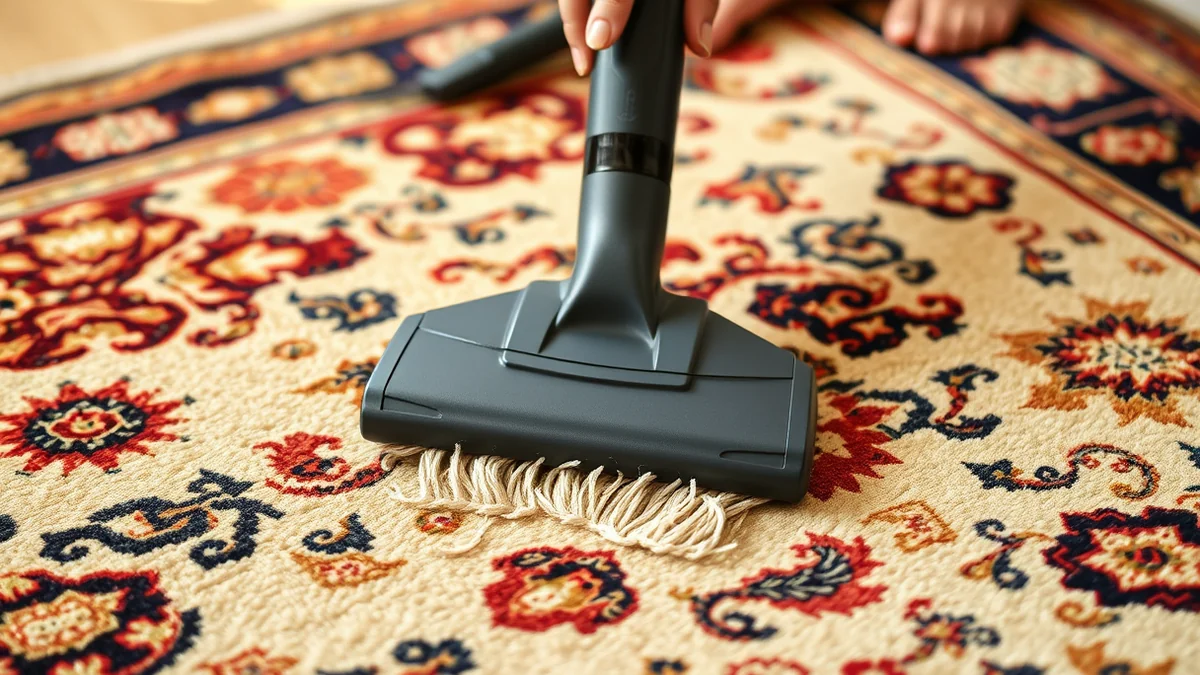
Consumer Reports’ guide to antique and area rugs warns that the rotating brush of a modern upright vacuum is too harsh for handmade rugs. It suggests a canister vacuum or a setting that turns off the rotary brush and gives suction only. Vacuum in the direction of the pile, which you can find by running your hand along the rug: smooth one way, rough the other.
Consumer Reports also suggests vacuuming the back of the rug occasionally, because gritty dirt abrades the backing. Fold one end over, vacuum the back and the floor underneath, then do the other end.
After a monsoon dust storm, give the rugs near doors an extra pass. The fine dust that gets tracked in during our storm season is exactly the sort of grit that wears pile down.
How to clean a Persian rug spill, step by step
Speed matters. Arizona’s dry air means spills can dry into the fibres quickly.
1. Blot immediately. Use a clean white cloth or paper towels and press, don’t rub. Work from the edges of the spill in toward the center so it doesn’t spread. 2. Test the dyes. Rub a damp white cloth over a dark area in an out-of-the-way spot. If colour comes off, the rug may bleed when wet. Stop and call a professional. 3. Use cool water. Dampen a clean cloth and blot the area to dilute what’s left. Keep the water to the surface; don’t soak through to the foundation. 4. Add a little wool-safe detergent only if needed. A very dilute solution, blotted on and then blotted off with plain water, so no residue is left behind. 5. Dry it quickly and flat. Press with dry towels, then prop the area up so air can reach both sides and point a fan at it. No hair dryers and no direct heat.
If the spill soaked through to the back, or it was pet urine, don’t try to deal with it on top alone. Liquid that reaches the foundation can cause odour, dye bleeding and rot, and it needs a proper wash.
What to use and what to avoid
Knowing how to clean a Persian rug is mostly knowing what to keep away from it.
| Product or method | Safe on a Persian rug? | Why |
|---|---|---|
| Cool water and blotting | Yes | Dilutes spills without disturbing dyes, if the rug is colourfast |
| Very dilute wool-safe detergent | Yes, sparingly | Gentle on wool; must be rinsed out so residue doesn’t attract dirt |
| Clear dish soap, a drop in water | Only for small spots | Can lift a greasy mark, but residue is hard to rinse from dense pile |
| Carpet shampoo or rental carpet machine | No | Too much water and residue, and strong formulas can affect dyes |
| Steam cleaning | No | Heat and moisture can make unstable dyes run and soak the foundation |
| Bleach or oxygen bleach | No | Can strip or shift natural and older dyes permanently |
Always test anything on a hidden corner first, even products labelled safe for wool.
Caring for the fringe
The fringe on a hand-knotted rug is part of its structure. If the fringe wears away, the knots at the ends can begin to come loose.
- Keep the vacuum off it. Consumer Reports suggests covering the nozzle with an old nylon stocking or using a suction-only setting so the fringe isn’t sucked up.
- Comb it straight with your fingers or a wide-tooth comb instead of vacuuming it.
- Don’t bleach it to make it whiter. That weakens the cotton or wool.
If the fringe is already fraying or the end knots are loosening, that’s a repair question, not a cleaning one. Mention it when you bring the rug in.
Can you dry clean a rug?
Can you dry clean a rug the way you dry clean a coat? Sometimes, but for most Persian rugs it isn’t the right method. Rugs are also far larger and heavier than anything that goes through a garment machine.
The right method depends mostly on the fibre. Consumer Reports notes that wool-pile rugs should generally be wet-cleaned, silk-pile rugs generally dry-cleaned, and rayon-pile rugs dry-cleaned only. It also points out that a handmade rug labelled all wool may have a cotton fringe or foundation. That is why a professional should look at the rug and test it before choosing a method.
Sun, dust, moths and storage
- Sun. Direct Arizona sun through a window fades dyes over time. Close blinds during the brightest hours, and rotate the rug now and then so wear and fading stay even.
- Pads. A good rug pad stops slipping and reduces wear from the floor below.
- Moths. Clothes moths and carpet beetles eat wool rugs as well as sweaters, especially under furniture where nobody vacuums. Our guide to moth damage and how to stop it explains the signs.
- Storage. Clean the rug first, then roll it pile-side out rather than folding it, wrap it in breathable fabric rather than plastic, and store it off the floor somewhere cool and dry.
Are old Persian rugs worth anything?
Some are, and some aren’t, and age alone doesn’t decide it. The things that matter include:
- Age, and whether the rug is genuinely antique or just old.
- Knot density, meaning how finely it was knotted.
- Materials and dyes, such as wool quality, silk, and natural dyes.
- Origin and design, including the weaving region and the rarity of the pattern.
- Condition: worn pile, repairs, moth damage, fading and dye runs all matter.
A cleaner can’t value a rug, and we won’t guess. If you think yours might be valuable, have it appraised before any cleaning or repair. The American Society of Appraisers directory lets you search for personal property appraisers; ask whether they specialize in rugs.
When to bring it to a professional
Knowing how to clean a Persian rug at home covers vacuuming and small spills. Bring it in when:
- A spill has soaked through to the back, or the rug smells musty.
- The colour test shows the dyes may run.
- It hasn’t been properly cleaned in years and looks dull all over.
- There’s pet urine, moth activity or a stain you’ve already tried to treat.
Rug cleaning is one of our specialty services, and our post on what happens to a rug at our Mesa shop walks through the process. We look at every rug before we agree to clean it and tell you honestly if we’d be cautious.
Be aware that some rugs are better off with a specialist. A valuable antique, a silk rug, or one that is fragile, with dry rot or loose knots, may need a rug specialist or a textile conservator. The American Institute for Conservation’s directory lets you search for conservators who specialize in textiles, including carpets. We’d rather tell you that than risk a piece that can’t be replaced.
The bottom line
How to clean a Persian rug at home is mostly about restraint: vacuum gently with suction only, blot spills with cool water, test the dyes, keep the fringe away from the vacuum and never soak it. Everything beyond that is a job for a professional, and for a valuable rug, a specialist.
If your rug needs more than a spot cleaned, call us on (480) 969-9982 to talk it through. You can bring it to our store at 1911 E Brown Rd, Mesa, use the 24-hour drop-off box outside for smaller rugs, or ask about East Valley pickup and delivery on Wednesdays and Fridays, scheduled by phone. Our contact page has hours and directions.
Bipin Kanabar — Owner, Bartoli Cleaners & Laundry, serving Mesa since 1957.
Frequently asked questions
Are old Persian rugs worth anything?
Some old Persian rugs are worth a great deal and many are not; it depends on age, knot density, materials, dyes, origin and condition. Heavy wear, moth damage, fading and poor repairs all reduce value. A cleaner can’t value a rug, so if you think yours may be valuable, have a qualified appraiser who specializes in rugs look at it before any cleaning.
How to tell if it’s a real Persian rug?
Start by checking whether it’s hand-knotted: turn it over and look for the pattern clearly visible on the back, with individual knots in slightly irregular rows. The fringe should be the ends of the warp threads, not sewn on. A glued canvas backing or perfectly regular back suggests a tufted or machine-made rug. Confirming true Persian origin takes an expert.
Can I use Dawn dish soap to wash my rug?
A drop of clear dish soap in cool water can help lift a small greasy spot, but you shouldn’t use it to wash a whole Persian or wool rug. Soap is hard to rinse out of dense pile, and leftover residue attracts dirt. Test on a hidden corner first, blot rather than scrub, and rinse the spot with plain water.
Can you dry clean a rug?
Some rugs can be dry-cleaned, but most wool rugs shouldn’t be. Consumer Reports notes that wool-pile rugs should generally be wet-cleaned, while silk-pile rugs are generally dry-cleaned and rayon-pile rugs must be. The right method depends on the fibre, dyes and construction, so a professional should inspect and test a handmade rug before choosing.
How often should a Persian rug be professionally cleaned?
Consumer Reports suggests professional cleaning every one to three years, depending on how much foot traffic the rug gets. A rug in a busy hallway or near an entrance needs it more often than one in a quiet bedroom. Between cleanings, regular gentle vacuuming and prompt blotting of spills keep it in good condition.