A suit can be a good cut, a good cloth and the right size on the label, and still look borrowed. Usually the problem is one or two details: sleeves that swallow the shirt cuff, a collar that stands away from the neck, trousers pooling over the shoe.
So how should a suit fit? The short version: the shoulders end where yours end, the collar rests on your shirt collar, a little shirt cuff shows, the jacket just covers your seat, and the trousers meet your shoes cleanly. The longer version, below, goes through each check in the order we make them at the counter, and says which problems a tailor can fix and which mean the suit is the wrong size.
That order matters. When someone asks us “how should a suit fit?”, we start with the parts that are close to impossible to change and finish with the easy ones.
Contents
- Start with the shoulders
- How should a suit fit at the collar and chest?
- Jacket sleeve length and the shirt cuff
- Jacket length and waist
- Trousers: seat, rise and break
- What can be altered and what cannot
- How should a blazer fit?
- Bringing a suit to our Mesa counter
- The bottom line
- Frequently asked questions
Key takeaways
- Any answer to “how should a suit fit?” starts at the shoulders: if the seam hangs past your own shoulder or pinches it, choose a different size.
- Suitsupply’s fit guide says a jacket sleeve should leave about half an inch (1.5 cm) of shirt cuff visible.
- The jacket collar should rest against your shirt collar with no gap and no pressure.
- A classic jacket just covers your seat; trousers take one break at the shoe or sit at the top of it with no break.
- Taking in and hemming are routine alterations; letting out depends on the fabric left in the seams, and shoulders are rarely worth changing.
Start with the shoulders
Put the jacket on, button the top button (or the middle one on a three-button), and look at where the shoulder seam ends. It should stop where your own shoulder stops. Suitsupply’s fit guide puts it simply: the shoulder should rest along the natural shape of your shoulder with no overhang.
Signs the shoulders are wrong:
- Too wide: the seam hangs past your shoulder and there is a dent in the top of the sleeve.
- Too narrow: the sleeve head pulls, and you see ripples across the top of the arm.
- Wrong slope: folds run diagonally from the collar toward the armpit.
We start here because the shoulder is built into the structure of the jacket: padding, canvas, sleeve head and collar all meet at that point. Reworking it means taking the top of the jacket apart. If you are between sizes, the answer is almost always to pick the size that fits the shoulders and alter everything else.
How should a suit fit at the collar and chest?
Next, look at the back of the neck in a mirror or a photo. Suitsupply’s guide says the jacket collar should sit naturally on the shirt collar, without pressing into it or leaving a gap. A collar that stands away from the shirt, or rolls into a bump just below the neck, is a fit problem, and usually a sign the jacket’s balance or shoulders are off for your posture.
Then the chest. With the jacket buttoned:
- The lapels should lie flat against your chest, not bow out.
- There should be no X-shaped creases pulling from the button, which means the jacket is too tight.
- You should be able to slide a flat hand inside the chest over your shirt, but not a fist.
- Lift your arms and reach forward. Some pull across the back is normal; the whole jacket riding up to your ears is not.
A little extra room in the chest and waist is normal off the rack and can be taken in. A jacket that is tight across the chest is harder, because it can only be let out as far as the seam allowance allows.
Jacket sleeve length and the shirt cuff
Sleeves are the detail people notice first.
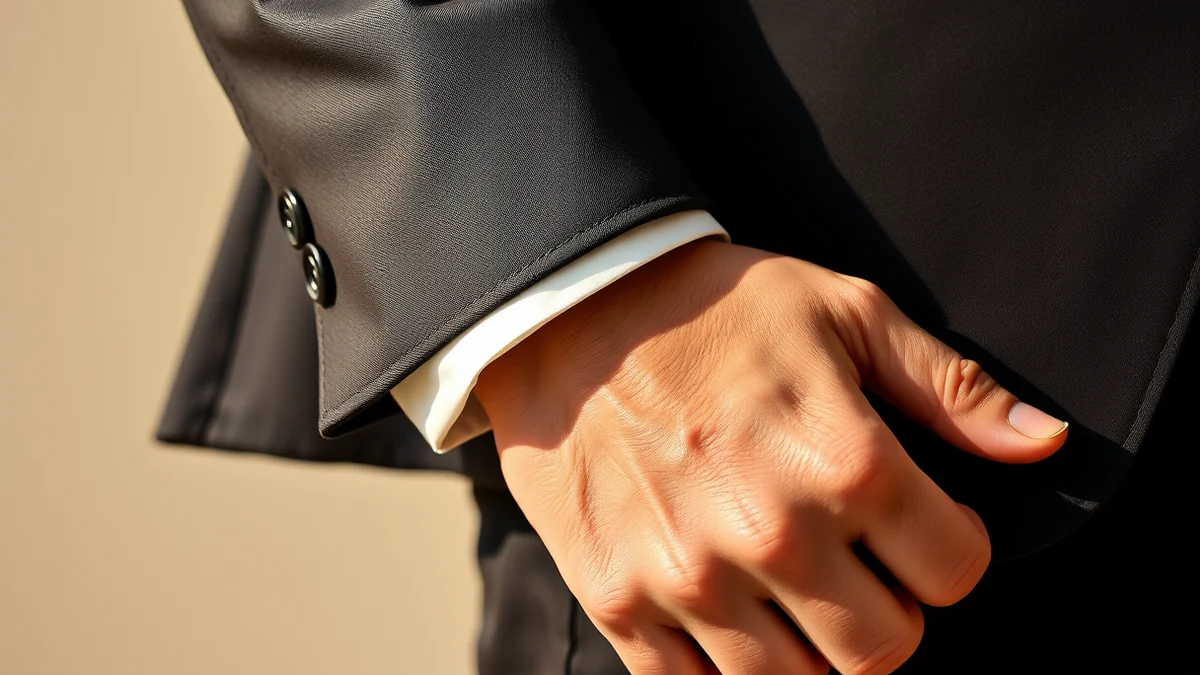
Stand with your arms relaxed at your sides. Suitsupply’s guide says the jacket sleeve should end a little above the point where your wrist meets the base of your thumb, leaving about half an inch (1.5 cm) of shirt cuff visible. The sleeve should hang straight, without twisting toward the back of your hand.
| What you see | What it means | Usual fix |
|---|---|---|
| No shirt cuff showing | Sleeves too long, or shirt sleeves too short | Shorten jacket sleeves, or check the shirt fits first |
| A little shirt cuff showing | Correct | Nothing |
| A lot of shirt cuff and wrist showing | Sleeves too short | Let down, only if there is enough fabric inside the cuff |
| Sleeve twists or creases at the elbow | Sleeve pitch is off for your arm | A more involved change; ask before committing |
Check your shirt before blaming the jacket. Shirt sleeves that are too short hide under any jacket, and loose cuffs slide down over the hand whatever the jacket does.
Jacket sleeves are shortened either from the cuff or, on some jackets, from the shoulder. If your sleeves have working buttonholes, the change is more complicated, because the buttonholes cannot be moved. The O*NET occupational profile for tailors and custom sewers lists taking up or letting down hems on garment parts such as sleeves among a tailor’s standard tasks. Every jacket is built differently, so call and ask whether your sleeves can be shortened or lengthened before you drop it off.
Jacket length and waist
For a classic look, Suitsupply says the jacket’s hem should only just cover your bottom. Stand straight with arms relaxed. A jacket that stops above your seat looks short and cuts your body in half; one that reaches well past it looks like an overcoat.
Get length right at purchase. A jacket can sometimes be shortened slightly, but pockets and buttons are placed for the original length, so there is little room to move.
The waist should taper in gently; Suitsupply’s guide calls for a slight taper there for a clean silhouette. If the jacket hangs like a box from the chest down, it can usually be taken in at the side or back seams, one of the more routine suit alterations.
Trousers: seat, rise and break
How should a suit fit below the jacket? The trousers matter just as much, and they are the half people forget to try on properly.
- Waist: sits where it was designed to sit, holds up without a belt pulling it tight, no gap at the back.
- Seat: Suitsupply describes the back of the trousers as a smooth drape over your seat. Horizontal pulls mean too tight; a sag under the seat means too loose.
- Legs: hang straight, crease centered, no clinging at the thigh.
- Length: one small break at the front of the shoe for a classic look, or just touching the top of the shoe with no break for a more modern one, as the same guide suggests.
Our guide to pants alterations covers each of these in more detail, including what decides whether a pair can be let out or tapered.
What can be altered and what cannot
Here is how the common problems usually sort out once we see the suit on you.
| Area | Alteration | How realistic |
|---|---|---|
| Trouser hem | Shorten, or let down if there is fabric | Routine for shortening; letting down depends on the hem allowance |
| Trouser waist and seat | Take in or let out | Taking in is routine; letting out depends on seam allowance |
| Jacket waist | Take in | Usually straightforward |
| Jacket sleeves | Shorten or lengthen | Depends on the cuff and buttonholes; call and ask |
| Jacket length | Shorten | Limited by pocket and button placement |
| Chest | Let out | Limited; tight chests rarely become comfortable |
| Shoulders | Narrow, widen, or reshape | Rarely worth it; choose a different size |
The general rule is that making something smaller is easier than making it bigger, and anything that involves the shoulder is the hardest of all. Our post on what a suit alteration can and can’t change goes into each of these jobs.
How should a blazer fit?
The rules for a blazer or sport coat are almost the same as for a suit jacket: shoulders end at your shoulders, the collar sits on the shirt collar, and a little shirt cuff shows. A blazer is often worn a touch more relaxed, especially over a sweater in winter, so try it on over what you will wear under it.
The shoulders still decide whether it is the right size.
Bringing a suit to our Mesa counter
Knowing the checks is half the job. The other half is a fitting where the tailor sees the suit on you with everything you will wear with it.
Bring:
- The dress shirt you will wear. Sleeve length is judged against the shirt cuff, so a T-shirt fitting gives the wrong answer.
- Your shoes and belt, for the trouser length and waist.
- What you usually carry. A phone and wallet in the jacket pockets change how it hangs.
- The date you need it by, if there is an event, so we can tell you honestly whether the work fits that timeline.
There is also a local reason to try your suit on early. In Mesa, plenty of people barely touch a suit through the hottest months, then pull one out for fall weddings and holiday events. Fit can change over a summer, and a suit that spent months in a hot closet or garage may need a press as well as a fitting. If it needs cleaning, our dry cleaning service can take care of that too; tell us at the counter and we will plan the order of the work. For how often a suit really needs cleaning between wears, see our guide on cleaning a suit less often.
Our alterations and repairs service covers hems, zippers, taking in, and formal wear. For sleeve changes, letting out or anything structural, call and ask whether your suit can be altered before you bring it in.
The bottom line
How should a suit fit? Shoulders first, then collar, chest, sleeves, length, waist and trousers, in that order. If the shoulders and chest fit, most of the rest can be adjusted. If they do not, a different size will serve you better than any alteration.
When you are ready, call us on (480) 969-9982 or come to 1911 E Brown Rd, Unit 1, Mesa, Monday to Friday 8 to 6 or Saturday 9 to 3, with the suit, shirt and shoes. For cleaning or finished work, there is a 24-hour drop-off box outside the store, and East Valley pickup and delivery runs on Wednesdays and Fridays, scheduled by phone.
Bipin Kanabar — Owner, Bartoli Cleaners & Laundry, serving Mesa since 1957.
Frequently asked questions
How long should suit sleeves be?
Suit sleeves should end just above the base of your thumb, leaving about half an inch of shirt cuff showing when your arms hang at your sides. That is the guidance in Suitsupply’s fit guide. If no cuff shows, the jacket sleeves are too long or the shirt sleeves are too short; if a lot of wrist shows, the sleeves are too short.
How should a blazer fit?
A blazer should fit like a suit jacket: shoulder seams ending at your natural shoulder, collar resting on your shirt collar, and a little shirt cuff showing. It can be slightly more relaxed through the body if you wear it over knitwear. Try it on over what you will actually wear underneath, and choose the size that fits your shoulders.
How do I know if my suit is too big?
A suit is too big if the shoulder seams hang past your shoulders, the sleeves cover your shirt cuffs, the jacket falls well past your seat, or the trousers bunch at the waist and pool over your shoes. Sleeves, waist and trouser length can often be altered. Shoulders that are too wide usually mean you need a smaller size.
Should a suit jacket cover your butt?
Yes, a classic suit jacket should just cover your seat. Suitsupply’s fit guide says the jacket hem should only just cover your bottom. Shorter jackets are a fashion choice, and much longer ones start to look like a topcoat. Length is hard to change afterwards because pockets and buttons are placed for it.
Can a tailor fix suit shoulders?
Rarely in a way that is worth it. The shoulder is where the padding, canvas, sleeve and collar meet, so changing it means taking apart the top of the jacket, and the result is not always convincing. Most tailors will advise choosing a size that fits your shoulders and altering the waist, sleeves and length instead.