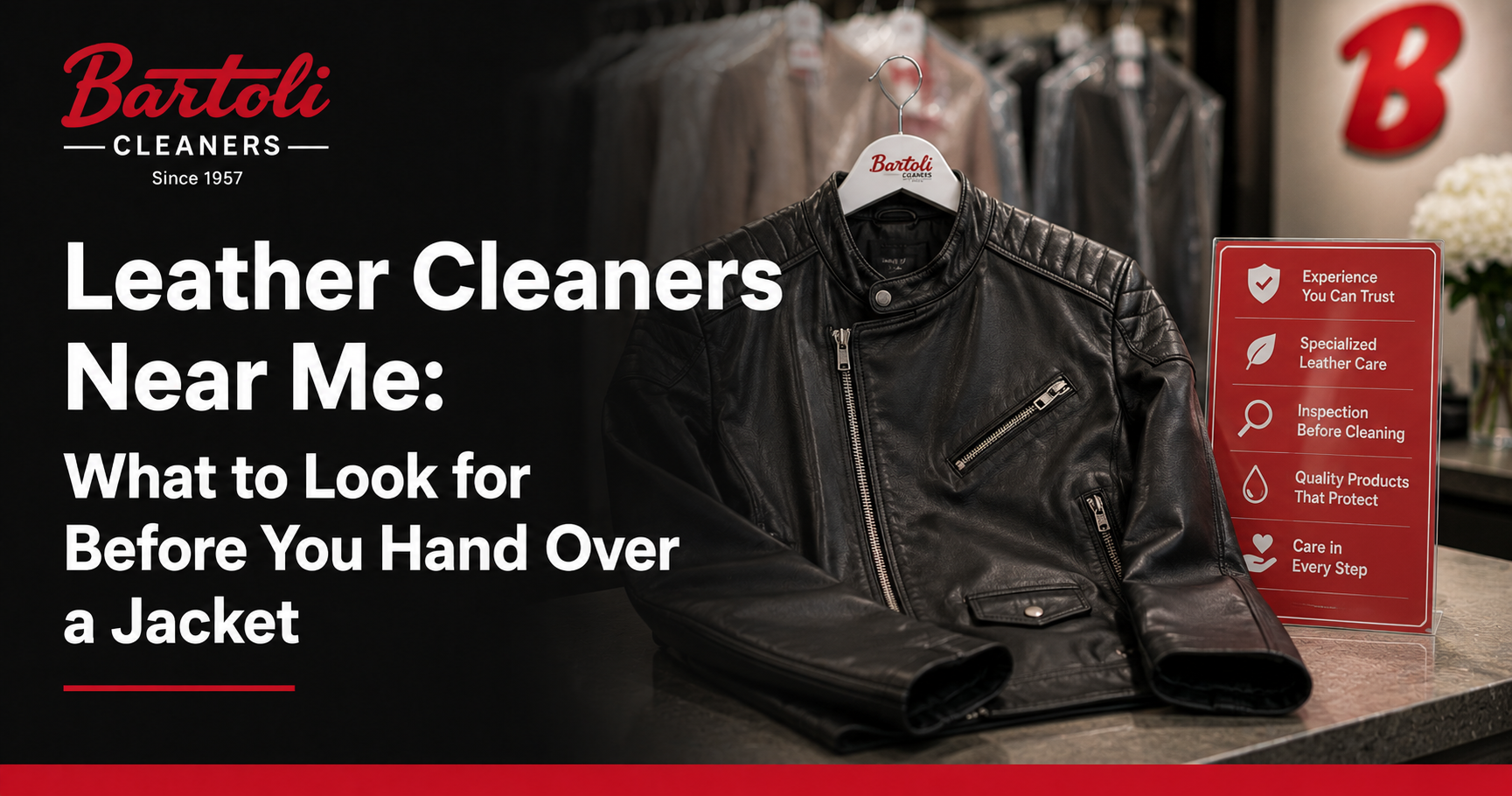
Leather Cleaners Near Me: What to Look for Before You Hand Over a Jacket
Leather and suede are not fabric, and that’s the whole reason a regular dry cleaner isn’t automatically the right place for them. A leather jacket is a hide that’s been tanned and finished — clean it with the wrong process and it can crack, stiffen, or lose its color permanently, and there’s no fixing that after the fact.
If you’re searching for leather cleaners near you, here’s what actually separates a shop that knows leather from one that’s willing to take your jacket anyway.
Key takeaways
- Leather and suede need a different cleaning process than fabric — not every dry cleaner offers it.
- The most common way leather gets ruined isn’t dirt, it’s improper drying and lack of conditioning afterward.
- Suede and nubuck are more fragile than smooth leather and show water spots and pressure marks easily.
- A good leather cleaner will ask about the type of leather before they ask about the stain.
- Leather should never go in a home washing machine or dryer, and dry-cleaning solvent used for fabric isn’t formulated for hide.
Why leather needs a different process than fabric
Fabric is woven fiber. Leather is animal hide that’s been tanned, dyed, and finished — it’s a completely different material with a completely different structure, and it responds to water, heat, and solvent in ways fabric doesn’t.
Standard dry-cleaning solvent is formulated to lift oils and stains from woven fiber without damaging dye or fabric structure. Leather has natural oils built into the hide itself that keep it supple, and the wrong solvent or process can strip those oils out along with the dirt — which is how a jacket ends up stiff, cracked, or discolored after a cleaning that was meant to help it.
The most common way leather actually gets ruined
It’s rarely the stain itself. It’s what happens after cleaning — specifically, drying without reconditioning. Leather that’s cleaned and then allowed to air dry without the oils being restored afterward comes out of the process stiffer and less supple than it went in, even if the visible stain is gone.
This is why a leather jacket that’s been “cleaned” a few times sometimes starts to feel like cardboard. The cleaning wasn’t necessarily wrong — the finishing step afterward was skipped.
Suede and nubuck need even more care than smooth leather
Suede and nubuck are leather with the finish reversed, exposing the softer underside of the hide. That makes them look and feel great, but it also makes them far more prone to water spots, pressure marks, and permanent staining than smooth leather.
A water spill on suede that would wipe off smooth leather without a trace can leave a dark ring that’s genuinely difficult to remove. Suede needs its own brushing technique and, in most cases, a different cleaning approach entirely from smooth leather — which is another reason it matters that whoever cleans it actually specializes in it.
What separates good leather cleaners near me from the rest
A search for leather cleaners near me returns a mix of general dry cleaners who accept leather as a sideline and businesses that treat it as a genuine specialism. The difference matters more than the search results suggest, because the same process that is safe on smooth leather can permanently mark suede.
Questions worth asking before you leave your jacket
- “Do you clean leather in-house, or does it get sent out?” A piece that travels to a third party has more handling and more chances for something to go wrong, and you lose the ability to ask questions directly to whoever actually does the work.
- “Will it be reconditioned after cleaning?” This is the step that keeps leather supple. If the answer is vague, that’s worth noting.
- “Have you worked with this type of leather before?” Lambskin, cowhide, suede and nubuck all behave differently — a shop that asks what kind of leather it is before answering is a good sign.
Caring for leather between professional cleanings
Wipe down smooth leather with a soft, slightly damp cloth to remove surface dust, and let it air dry away from direct heat or sun — a radiator or a hot car is one of the fastest ways to dry out and crack leather over time. Store leather jackets on a proper hanger with some shoulder shape, not folded, since folds can crease permanently into the hide.
For suede, a soft suede brush used in one direction lifts surface dirt without pressing it into the nap. Avoid water on suede altogether if you can — if a spill happens, blot gently and let it air dry rather than rubbing.
Leather and suede care at Bartoli Cleaners
Leather and suede are part of the specialty work handled at Bartoli Cleaners in Mesa, alongside comforters, rugs, and pillow cleaning. All the work is done on premises — the jacket that comes through the door is the one that gets cleaned, without being routed to a third-party plant.
For garments that need repair work alongside cleaning — a torn lining, a replaced zipper — Bartoli also handles Alterations & Repairs. For other specialty items beyond leather, see the full Specialty Services page.
Call us and describe the jacket — the type of leather if you know it, and what’s bothering you about its current condition — and you’ll get a clearer sense of what’s involved before you make the trip in.
What to look for when comparing leather cleaners near you
A search for leather cleaners near you will usually turn up a mix of general dry cleaners who accept leather as a side service, and businesses that treat it as an actual specialism. The distinction matters more than a list of leather cleaners near me search results tends to show.
A general cleaner may accept a leather jacket because turning away business is undesirable, even if leather isn’t really their strength. That’s not dishonest, but it does mean the outcome is less predictable than it would be with someone who handles leather and suede routinely enough to know the specific quirks of different hide types, dye processes, and finishes.
Reviews that specifically mention leather or suede work are worth more than a general star rating. A shop with excellent reviews for dry cleaning shirts and suits isn’t automatically the right choice for a vintage leather jacket — look for evidence they’ve actually handled leather and suede specifically, not just garments generally.
Care labels are not optional guesswork: under the Federal Trade Commission’s Care Labeling Rule, manufacturers must state a safe cleaning method for the garment, and that label is the first thing any leather specialist should read.
Whichever of the leather cleaners near me you settle on, ask the same three questions: is the work done in-house, will the piece be reconditioned after cleaning, and have they handled this type of leather before.
Frequently asked questions
Can you remove stains from a leather jacket?
Many stains can be treated, but the outcome depends on the type of leather, the finish, and how long the stain has been set. Bring the jacket in for an assessment rather than treating it at home first, since a home attempt can sometimes make professional treatment harder.
Is it safe to machine wash a leather jacket?
No. Water and agitation in a home washing machine can permanently warp, shrink, or crack leather, and there’s no reversing that damage. Leather needs a specialist cleaning process, not a home wash cycle.
How often should a leather jacket be professionally cleaned?
Leather doesn’t need cleaning as often as fabric — once a year for regularly worn pieces is a reasonable guide, more often if it’s been exposed to rain, spills, or heavy use. Over-cleaning can be as hard on leather as under-cleaning.
Do you offer pickup and delivery for leather items?
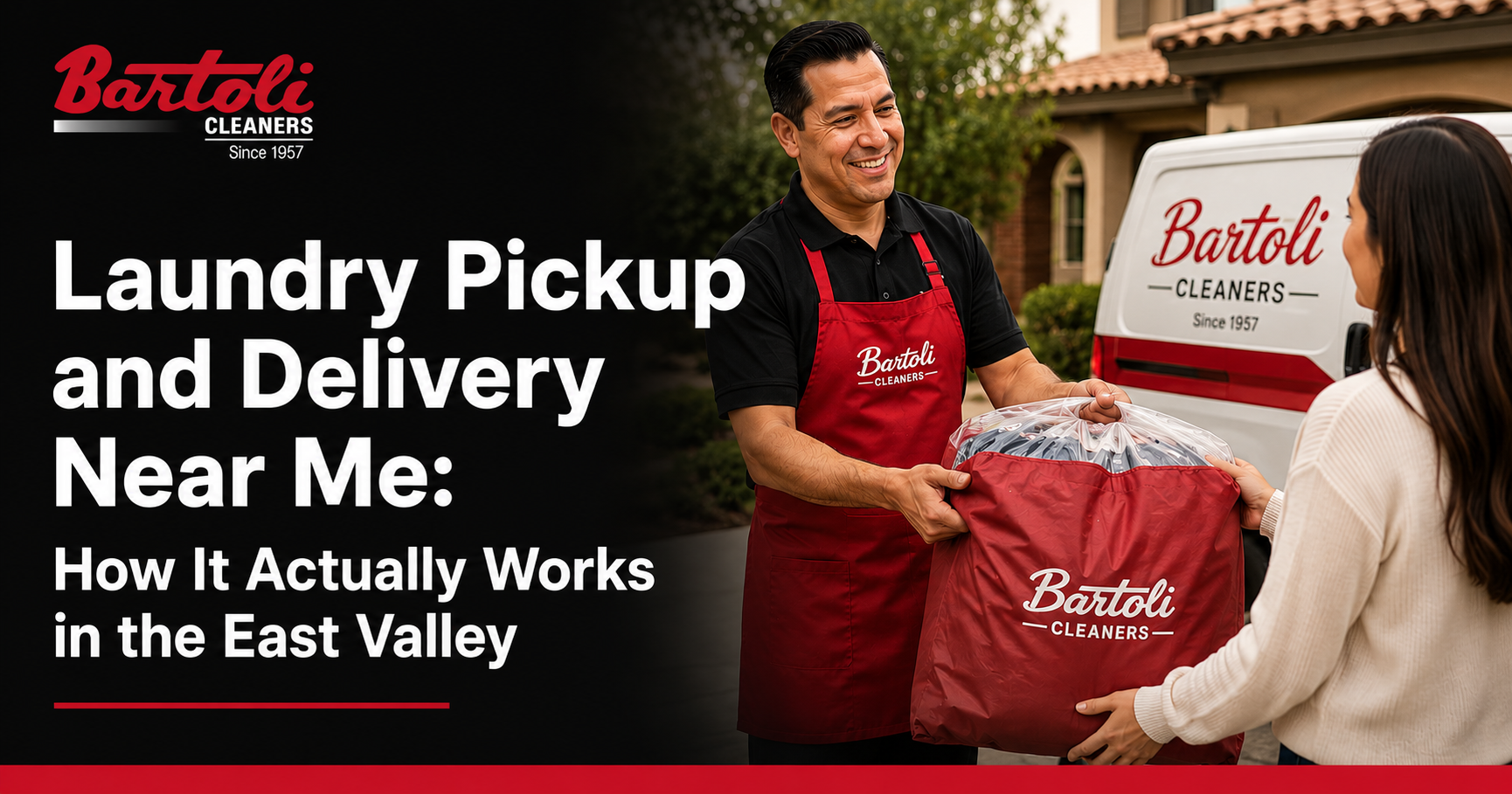
Yes, as part of Bartoli’s regular East Valley pickup and delivery, which runs Wednesdays and Fridays and is scheduled by phone.
What’s the difference between suede and nubuck?
Both are leather with a napped, textured finish rather than a smooth one. Suede is typically made from the underside of the hide and tends to be thinner and softer; nubuck is made from the outer side of the hide sanded to create a similar texture, and is usually more durable. Both need specialist, water-cautious cleaning rather than the process used for smooth leather.
This article reflects general leather-care practice. For an assessment of a specific garment, contact Bartoli Cleaners directly.