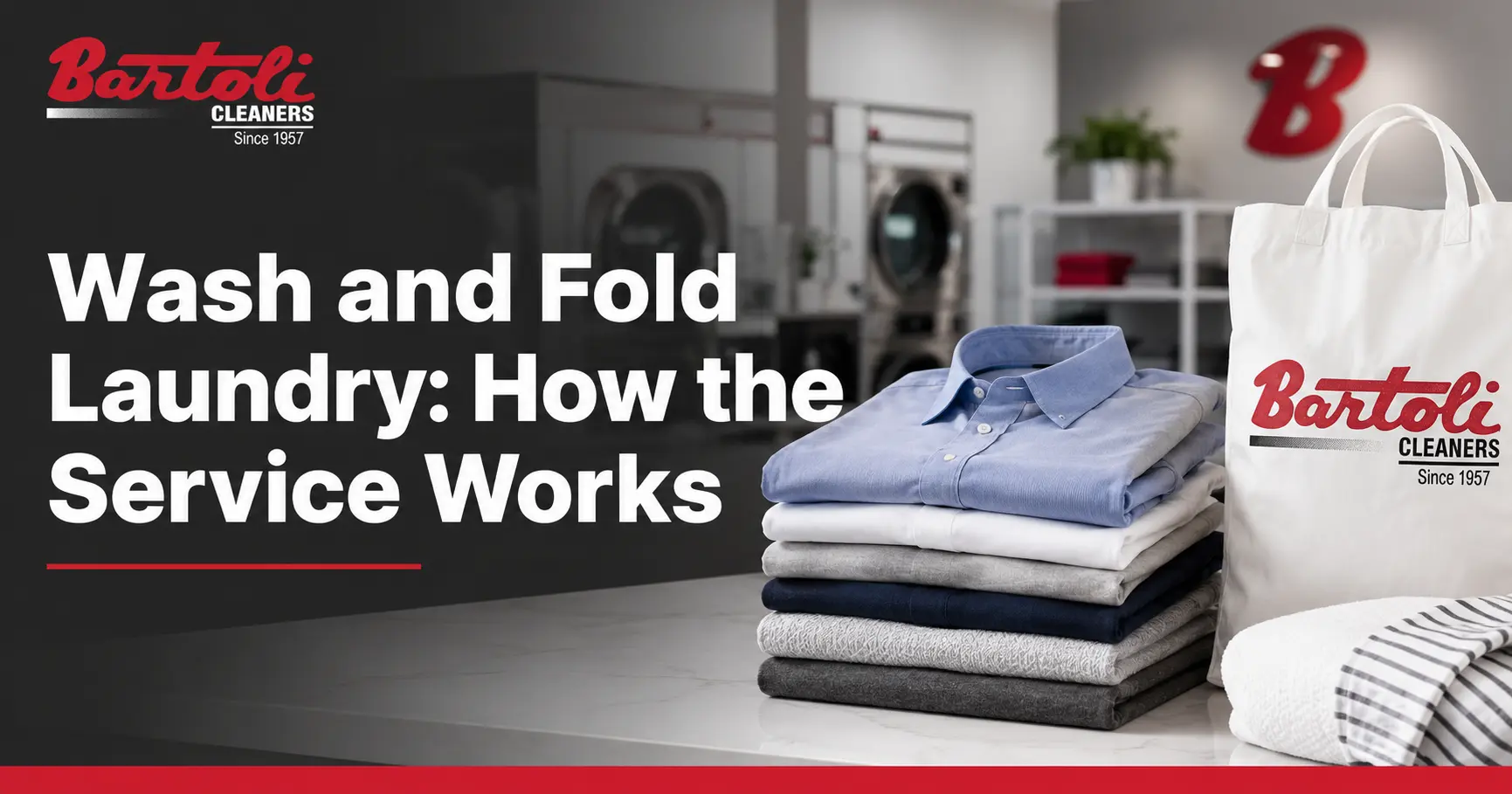
Wash and fold is the least glamorous service a cleaner offers and, for a lot of households, the one that changes the week most.
It is also frequently misunderstood — people assume it is dry cleaning for ordinary clothes, or that it is only for people who do not own a washing machine. Neither is right.
What wash and fold actually is
Wash and fold is exactly what it sounds like: you bring in everyday laundry, it is washed, dried, folded and returned ready to put away.
It is a wet wash — ordinary laundering with water and detergent, the same process as at home, done at commercial scale with commercial equipment. That is the key distinction from dry cleaning, which uses solvent rather than water and is for garments that would be damaged by a normal wash.
Most of what a household generates every week is wash-and-fold work: t-shirts, jeans, underwear, socks, towels, bed linen, gym clothes, children’s clothing, casual wear. Structured, delicate and tailored items are the ones that need dry cleaning instead.
Our wash and fold service covers the everyday load.
Who it is actually for
The service tends to make sense for a few specific situations, and they are more common than people expect.
Households where nobody has the time. Two working adults, children, and the machine at home is running constantly but never quite catching up.
People without good laundry facilities. Apartments with shared machines, or homes where the laundry setup is awkward.
Anyone who travels. Coming home to a suitcase of laundry after a trip is the reliable low point of travelling.
Households with a lot of bedding and towels. Bulky items are the worst part of home laundry — they take the longest to dry and take up the whole machine.
People recovering from illness or injury, or new parents. Periods where the ordinary running of a house becomes genuinely hard.
Anyone who has simply decided their weekend is worth more than four loads. That is a perfectly good reason.
What to do before you bring it
A few minutes of preparation improves the result noticeably.
Empty every pocket. Tissues, pens, receipts and lip balm cause the majority of avoidable problems. A pen through a wash affects more than the garment it was in.
Separate anything that is not everyday laundry. Anything structured, tailored, delicate, beaded or labelled dry-clean-only should be kept apart — it belongs in a different process.
Point out stains. Tell us what is stained and, if you know, what caused it. A stain treated correctly first time is far more likely to come out. This is the single most useful thing you can do.
Mention anything new or brightly coloured. New reds and dark denim can bleed on first washing.
Keep household items separate. Comforters, blankets, rugs and pillows are handled differently from clothing — see our specialty services.
Say if anything is delicate or sentimental. A garment you would be upset to lose should be flagged rather than assumed.
What good wash and fold looks like
Not all wash and fold is the same, and the differences show up over time.
Sorting. Loads should be separated sensibly — colours, whites, fabric types, and heavily soiled items apart from lightly soiled ones.
Appropriate temperatures. Everything washed hot is fast and damaging. Care labels exist for a reason.
Attention to stains. Items should be checked rather than simply loaded.
Proper drying. Over-drying is what causes shrinkage, wear and that stiff feel on towels. It is also the most common corner cut.
Consistent folding. So it can go straight into a drawer.
Handled by people you can talk to. At Bartoli all work is done on premises on E Brown Rd. Many storefronts send laundry to a central plant, which means the people washing your clothes never see the customer and cannot ask about the stain on the collar.
The practical details
Hours. We are open Monday to Friday, 8am to 6pm, and Saturday 9am to 3pm. Closed Sundays.
After-hours drop-off. There is a 24-hour drop-off box outside the store, so you can leave laundry whenever suits you and we will process it when we open.
Pickup and delivery. We collect and deliver across the East Valley on Wednesdays and Fridays. It is arranged by phone — call us and we will set it up. If you want a routine, building it around those two days works well.
Turnaround. Ask when you drop off. Standard loads are quick; bulky household items take longer because of drying time.
Everything under one roof. If some of what you bring turns out to need dry cleaning, or a garment needs a button or a seam repaired, we handle that here too rather than sending it elsewhere.
When it is not the right service
Being straight about this saves disappointment.
Anything structured, tailored or delicate should be dry cleaned, not wet washed — suits, formal wear, lined jackets, silk, fine wool. If a care label says dry clean only, it is saying so because water and agitation will damage it.
Heavily soiled work clothing may need specific treatment rather than a standard wash.
And anything irreplaceable — an heirloom, a christening gown, a wedding dress — belongs in specialty handling with proper inspection, not in a general load.
If you are unsure which category something falls into, bring it in and ask. Sorting it correctly at the counter is free and prevents the kind of mistake that cannot be undone.
What we see most often — and how to avoid it
After enough decades of doing this, the same handful of avoidable problems come through the door repeatedly.
Pens. By a wide margin the most common single cause of ruined laundry. One pen left in a shirt pocket affects everything in the load. Checking pockets takes thirty seconds and prevents most of the damage we see.
Tissues. Not damaging, but they disintegrate into thousands of fragments that cling to everything and take real effort to remove.
Stains nobody mentioned. A stain we know about gets pre-treated correctly. The same stain, unmentioned, goes through a normal wash and dryer — and dryer heat sets many stains permanently. Once that has happened, options narrow sharply. Telling us takes a moment and is the highest-value thing you can do.
Dry-clean-only items in the everyday pile. Usually a lined jacket or a silk blouse that got mixed in. We catch most of these at sorting, but flagging them is safer.
New dark denim and new red items. These bleed on first washing. Worth mentioning so they can be kept separate.
Items with sentimental value in a general load. If losing something would upset you, say so at the counter rather than assuming.
Getting more life out of everyday clothes
A few habits meaningfully extend how long ordinary clothing lasts, which matters more in this climate than most.
Wash sooner rather than when it looks dirty. In Mesa heat, perspiration salts and body oils build up quickly. They weaken fibres and oxidise into yellowing that becomes permanent. Waiting for visible dirt is usually waiting too long, particularly with summer shirts.
Do not over-dry. Excessive drying is the main cause of shrinkage, fibre wear, and towels going stiff and scratchy. Commercial equipment run properly dries to the right point rather than the fastest point.
Turn dark items inside out. Reduces fading from abrasion, and Arizona sun is unforgiving on anything hung outside.
Store clothes cool and dark. A hot garage or a sunlit closet degrades fabric measurably faster than a cool interior wardrobe.
Deal with small damage early. A loose button or a starting seam split is a quick repair. Left alone through several washes it becomes a bigger job. We handle repairs here too, so it can be sorted with the same drop-off.
Frequently asked questions
What is wash and fold laundry service? Everyday laundry washed with water and detergent, dried, folded and returned ready to put away. It is ordinary laundering done commercially, not dry cleaning — which uses solvent and is for garments that water would damage.
What should not go in wash and fold? Anything structured, tailored or delicate — suits, formal wear, lined jackets, silk and fine wool — plus anything labelled dry clean only. Household items like comforters and rugs are handled separately, and irreplaceable garments should go through specialty handling.
Do I need to sort my laundry first? We sort it, but you should empty pockets, separate anything that is not everyday laundry, and point out stains and what caused them. Flagging stains makes the biggest difference to the result.
How long does wash and fold take? Standard loads are quick; bulky items such as comforters and bedding take longer because of drying time. Ask at drop-off and we will give you a realistic date.
Do you collect and deliver? Yes, across the East Valley on Wednesdays and Fridays, scheduled by phone. There is also a 24-hour drop-off box outside the store for whenever it suits you.
Can I mix dry cleaning and wash and fold in one drop-off? Yes. Keep them separated and tell us which is which, and we will route each item to the right process. Everything is handled here on premises.